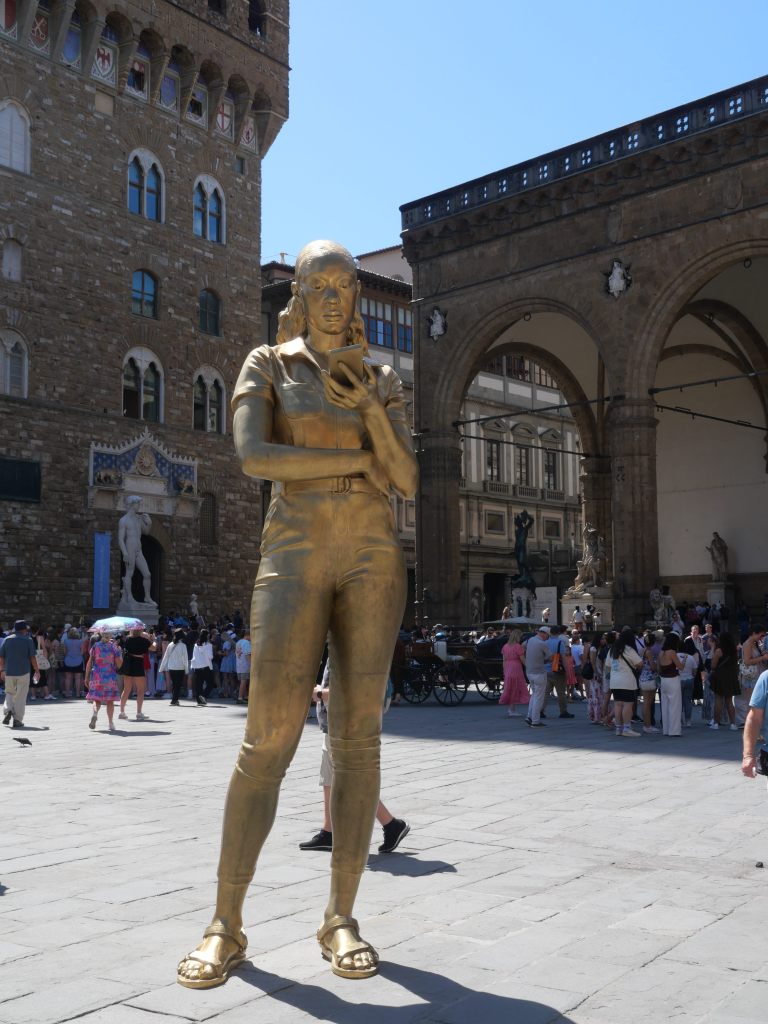
The artists of the Renaissance held to the principle that all art must strive to portray the ideal form of its subject. Thus, a simple scene became an epic, portraying meaning through every unique pose and expression, and a basic portrait became a perfected edition of oneself. The ideal does not entail exclusively portraying good, but instead portraying the essence of a thing effectively. Alas, Thomas J. Price’s recent exhibition of golden statues is anything but ideal—it is utterly ordinary. But, is that a problem? Should all art strive for the ideal, or is there value in the ordinary?
British Sculptor Thomas J. Price has spent the last several years touring his statues in public around the Western world, from the UK, to the Netherlands, to Italy, and to the United States. In 2025, social media responded to Price’s installations with some degree of outcry, showcasing the ordinary sculptures of black women in places such as Times Square and Florence. But, to investigate whether or not such outcry is warranted, it is best to begin with what Price believes the purpose of his work to be and what his intentions are.
Price’s philosophy of art views work through an unorthodox lens—that of power and universals over particulars. Price wrote in an article for TIME magazine, “Public sculptures and statues have been used to signpost, to exemplify what power looks like and to maintain the systems of power.” Price believes that because art reflects those in power, it must gloss over the uncomfortable parts of history. This is what he wishes to change, believing that society must face this discomfort head-on in the space of sculpture rather than forget about it.
When contemplating what should replace the statues that had recently been taken down in 2020, Price further elaborates on his view, stating, “…we could find alternative figures from history, but I think that’s still playing the game of aggrandizing particular individuals and setting people apart.” Implicit in this statement is a distaste for the particular individual in lieu of the universal idea of the individual by reason of particulars causing division. “All the figures I make are fictional, because I’m trying to critique the whole concept of portraiture,” Price adds. He opposes portraiture due to the money or fame required to commission a portrait. Price forgone any specific role in his sculptures, writing, “you don’t have to be an athlete, or strike a pose, or fulfil an expectation.” In this manner, Price’s statues embody the ordinary in a manner that starkly opposes the ideal form. Price’s imaginary characters also refuse to conform to the “expectations of dressing for success,” slouching and wearing h
Woven into Price’s philosophy of art is the idea of race. Price scornfully condemns the idea of white sculptors replacing the removed statues, calling them almost entitled and accusing them of possessing a white savior complex that exemplifies the problem of neglecting black experiences. Price explicitly speaks to the fact that his sculptures are intended to subvert the expectations placed on black people around the world.
The problem in Price’s mission is that it fails to be portrayed well through his artwork. It would be more evidently admirable if Price had made statues portraying the brutal violence endured by black populations to spell out his message, but he fails to do so. Portraying such conflict would stray from the ordinary and into the territory of the ideal form. Man does not work in universals; he works in particulars. Thus, specific examples of black excellence would prove far more useful and inspirational to portray than ambiguous examples of mundane existence. Nothing about Price’s statues explicitly calls for inspiration, and if it does, it does so at a minimal level and could do so better.
While it is certainly the case that black artists may offer unique understandings, to generalize white artists who wish to portray black struggles as having a savior complex is a leap in logic that Price fails to explain. It’s best to analyze such wishes in a good-faith manner, rather than simply shrugging these artists off as entitled. There is certainly a value that may be gained from a black artist replacing these statues through the aforementioned unique perspectives, but ultimately, the creator of the statue and their race matters far less than the effect and competency exuded by the statue. Whatever is best for the culture should be the primary factor in determining who is financed to make art, regardless of race. A far better argument, therefore, would be for Price to say that black artists are more likely to have a positive impact by being financed, and thus should be prioritized.
Yet, my criticisms are not an indictment of Price’s work altogether. Although Price’s philosophy is flawed and poorly portrayed through his work, the craftsmanship of his sculptures proves Price’s talent and understanding of realism. Undoubtedly, Price’s artistic abilities are admirable, and thus his sculptures are not devoid of value. It’s not wrong for Price to counter limiting tropes for black identities around the world and expand a more nuanced understanding of blackness, or wish that black people are commissioned for their unique perspectives in art. Similarly, it’s not a problem to want to see sculptures that look like you, so long as such a qualification does not exclude excellence.
Overall, it is worth portraying the ideal form through art to inspire and enrich the surrounding culture. Whether its the portrayal of a tale or the exaltation of a hero, humans receive information through specifics, not general vaguities. So, in opposition to Thomas Price, we should erect statues of the chest-puffing hero, because that hero inspires excellence. That hero is distinguished from the ordinary man because he is not the ordinary man, exemplified by his cultural contributions.
 De Facto Times
Leave a comment